






The University at Buffalo’s North Campus is set for a major transformation—not just from the new Empire AI supercomputing center, but as the backbone of an ambitious plan to cut carbon emissions and make the campus carbon neutral.
This initiative is part of the North Campus Clean Energy Master Plan (CEMP), a 25-year, $1 billion investment aimed at modernizing aging infrastructure. The plan will shift the campus from a mix of electricity and natural gas to a fully electrified system, cutting energy use by 30%, reducing greenhouse gas emissions, and lowering energy costs.
The university teamed up with Wendel Companies, who helped with UB’s South Campus decarbonization, to develop this plan. In fall 2025, Governor Kathy Hochul boosted the project with $68 million in state funding, including $62 million for Phase 1 of the North Campus plan and $6 million for the South Campus Parker Energy Hub.
Phase 1 Highlights
The first phase focuses on decarbonizing the Baker Chilled Water Plant, the campus’ central utility facility. New water pipes will link the Empire AI supercomputing center to the Baker plant, allowing the campus to capture and reuse the heat generated by the supercomputer. This project is in partnership with the New York Power Authority (NYPA).
SUNY Chief Sustainability Officer Carter Strickland says the project will be a “living lab” for clean energy technologies like geothermal and heat pumps—solutions that can be replicated in communities across New York.
Why Now?
UB’s North Campus includes 130 buildings with energy costs over $16 million annually. Much of the current system dates back to the late 1960s and relies on inefficient electric resistance heating. With nearly $2 billion in planned construction over the next decade—including new engineering buildings and the Empire AI center—this is the perfect time to invest in smart, sustainable infrastructure.
Laura Hubbard, UB’s vice president for finance and administration, emphasizes that “the cost of doing nothing is not zero,” and says decarbonization is both an environmental and financial investment that can save money long-term.
Modernizing Infrastructure and Technology
The plan calls for new infrastructure connections, upgraded heating and cooling systems, and integration of advanced technologies like artificial intelligence to optimize energy use and reduce waste across campus.
Jason Denue, vice president of energy for Wendel, highlights the collaborative spirit behind the plan, noting that progress is already underway as UB aligns existing initiatives with the new vision.
Empire AI and Clean Energy Innovation
Empire AI, launched in 2024 with over $500 million in funding, is a statewide research consortium including UB and other SUNY campuses focused on advancing AI for public good. UB houses the consortium’s supercomputing center, which will generate waste heat captured and reused to warm campus buildings.
NYPA has approved 15 megawatts of power for Empire AI, supporting the clean energy goals. The plan reduces the need for geothermal wells by nearly 90%, cutting costs and campus disruption.
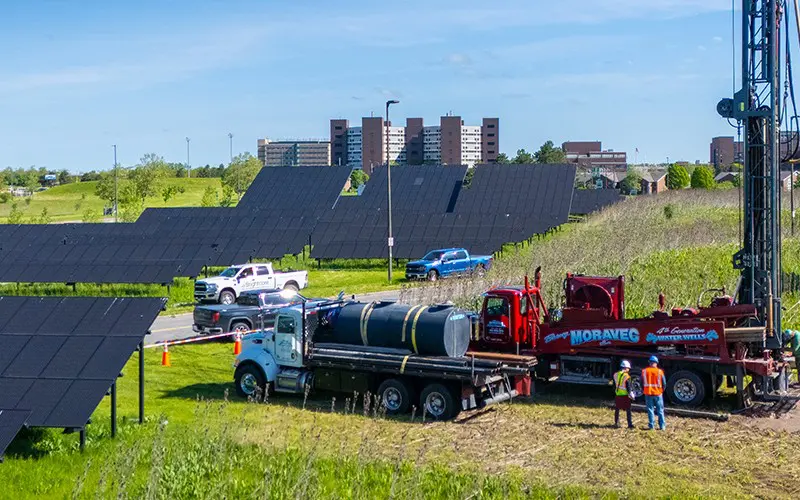
The Baker Chilled Water Plant will receive new heat exchangers and electric heat pumps to distribute this heat, supported by geothermal wells near the UB Solar Strand. Sharing heating and cooling between buildings through existing infrastructure saves energy and money.
Partnerships Driving Change
Ryan McPherson, UB’s chief sustainability officer, credits the collaboration between UB, SUNY, NYPA, Governor Hochul, and the State Legislature for enabling what could be the largest infrastructure upgrade in UB’s history.
Joe Kessler, NYPA’s executive VP, calls the project “an ambitious demonstration of how innovative thinking and partnerships can deliver scalable clean energy solutions.”