






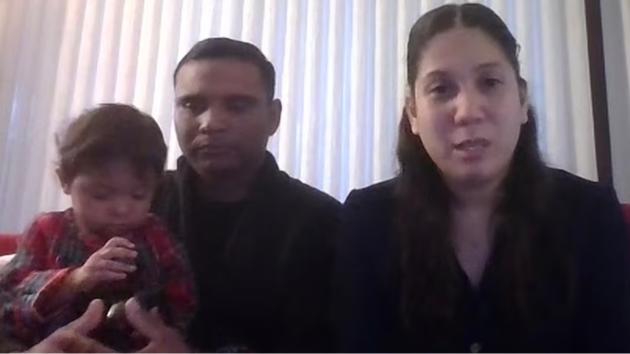
(NEW YORK) — As Khelin Marcano was preparing for her routine scheduled appointment with Immigration and Customs Enforcement in December, she debated packing a bag full of her 1-year-old daughter’s clothes. While she and her husband had been attending appointments without issue, she knew others were being detained at government buildings by immigration authorities.
“When they told us we were being detained, it felt like we already knew, all along,” Marcano told ABC News.
The family, including 1-year-old Amalia, was quickly sent from El Paso to Texas’ Dilley immigration detention center, where they were detained for 60 days — joining hundreds of other families that the government has held for durations that advocates say exceed the limits established by federal court rulings.
Those restrictions stem from the Flores Settlement, a 1997 legal agreement that a federal court has interpreted to mean that the government generally should not hold children in immigration custody for more than 20 days.
As of last month, there were about 1,400 people being held at Dilley, including children and parents, according to RAICES, a legal immigrant advocacy group. The facility was closed during the Biden administration and was re-opened last year as the Trump administration’s immigration crackdown ramped up.
The 60 days that Marcano, her husband Stiven Prieto, and their daughter were held there is three times the general legal limit permitted by the settlement.
“The Trump administration is holding children and families in detention for prolonged periods of time, weeks, months,” Elora Mukherjee, the family’s lawyer, told ABC News. “Children and families at the Dilley facility don’t have access to sufficient clean drinking water, where they don’t have access to sufficient nutritious food, [and] don’t have access to adequate medical care.
‘Why does this happen to us?’The family entered the U.S. using the Biden-era Customs and Border Protection app in 2024, according to court documents. They were processed and granted parole to live in the country while applying for asylum. The family was released last week after their 60-day detention and their first court date is scheduled for 2027, according to their attorney.
A spokesperson for the Department of Homeland Security said the family “was released into the country under the Biden administration,” and confirmed their detention.
“For years, the Flores consent decree has been a tool of the left to promote an open borders agenda,” the DHS spokesperson said. “It is long overdue for a single district in California to stop managing the Executive Branch’s immigration functions. The Trump administration is committed to restoring common sense to our immigration system.”
Early on during their detention, the family says 1-year-old Amalia developed a persistent fever. Marcano told ABC News that despite her repeated pleas for medication, the medical staff dismissed the symptoms.
“The doctor told me that fever was a good sign because it meant she was actively fighting a virus,” Marcano said in Spanish. “I got really upset … and told her that whatever the case was, a fever is not a good thing. If she didn’t know that fever could kill people, or that fever could cause convulsions, fever would never be good.”
In a habeas petition Marcano filed against the government, she and her attorney claimed the Dilley facility lacked basic hygiene and nutrition, and that they saw bugs in the food. They alleged that the tap water smelled so strongly of chlorine that the family spent their limited funds on bottled water for their daughter.
Marcano told ABC News that at one point during their detention, Amalia seemed to lose her strength and collapsed in her arms.
“I grabbed her and I dressed her and I took her back to the clinic, and I began to argue with the doctors, asking who would be responsible for my daughter if something happened to her,” Marcano said.
Marcano said it was only then that staff at Dilley transported her and Amalia by ambulance to a regional hospital, and later to a larger hospital in San Antonio. The 1-year-old was diagnosed with COVID-19 and a respiratory virus. according to the family and their habeas petition.
According to Marcano’s complaint, hospital staff provided her with a nebulizer and Albuterol to treat Amalia’s respiratory distress — but when they returned to the Dilley facility, the staff immediately confiscated both the nebulizer and the medication.
“They took her treatment away,” Marcano said. “Why does this happen to us if we have done everything right? I was begging the officers to please help me get out of there, and no one listened to me.”
The family was released together shortly after they filed a habeas petition. Marcano told ABC News that, while inside the facility, she met families with pregnant women and saw children as young as 2 months old.
Long-term effectsSeveral immigrant advocates and attorneys told ABC News that the Trump administration is keeping children and families who are seeking asylum and other forms of legal relief in prolonged detention.
In Minneapolis, where 5-year-old Liam Conejo Ramos was detained along with his father on their way home from school last month, local school officials told ABC News that immigration authorities had detained four other students from the district. One of them, 11-year-old Elizabeth Zuna Caisaguano, was detained along with her mother for more than one month, according to the family’s attorney, Bobby Painter.
“They were pulled over by ICE and pulled out of their car, thrown on an airplane and sent to Dilley, all in the span of maybe 24 hours,” the attorney said.
Some families have been held for months, attorneys told ABC News.
“The effects of detention are long-term on children,” Mukherjee, Marcano’s attorney, told ABC News. “Children who are with their parents and who are safe with their parents should never be detained when it’s not in a child’s best interest.”
The DHS, in a statement, said “being in detention is a choice.”
“We encourage all parents to take control of their departure with the CBP Home App,” the spokesperson said. “The United States is offering illegal aliens $2,600 and a free flight to self-deport now.”
Since being released, Marcano said her daughter hardly cries at night anymore like she did when they were at the detention center.
“We’re feeling very good and thank god for his blessings,” she told ABC News. “We’re still a little on edge about what we were planning to do given everything ahead. So we’re left here thinking about what is going to happen to us and that gives us a bit of fear.”
“Are they going to leave us alone?” Marcano said. “That’s what we hope, but we don’t know.”
Copyright © 2026, ABC Audio. All rights reserved.